
F.Y.I. why D.I.Y. may not always be I.Y.B.I. ( in your best interest)
Life has its surprises. In addition to all the possible mishaps with our homes, cars, plans and the weather to mention a few; our teeth will sometimes add to our daily challenges.
Typical scenarios are a broken or lost filling, loose or lost crown or bridge or perhaps some type of breakage with a full or partial denture. Less common is a sudden problem to natural tooth enamel.
The most common reasons for these problems are:
- An extra hard shock to our tooth or restoration while eating
- Eating something of more than recommended hardness or stickiness
- Using our teeth as tools
- Clenching and tooth grinding due to stress
- Dropping our mouth appliance on the floor or sink
- Traumatic injury – falling down, running into something or somebody
The above factors can cause a good tooth or strong restoration to break or become loose.
When a tooth has already been weakened by decay or has a filling or crown that is not in good condition, even mild forces can cause damage.
Another possibility is when we are undergoing treatment and have a temporary filling or crown or bridge, denture, etc. Brushing too vigorously or chewing even the softest foods can break or dislodge temporaries. Dislodging temporaries while flossing is also a possibility.
(images of broken crowns and temporaries)
(images of broken crowns and temporaries)


The problems we see or hear about most commonly are:
1) The crown or bridge does not get reinserted correctly – bite is off; restoration is raised so that repeat loosening is a probability and worse yet, decay or serious staining can get under the crown.
2) The tooth does not get cleaned and dried without having access to dental instruments and equipment and professional experience.
3) The excess glue cannot be adequately cleaned off or the crown is bumped loose in the attempt.
4) The patient secures the crown or bridge but does not follow up with the dentist. In the future significant decay is found.
5) The glue sticks to the patient’s fingers, lips, tongue or opposing teeth.
6) The restoration falls into a sink or is swallowed.

Temporary cements available in pharmacies or even at your dental office may be free of toxic substances in household or commercial adhesives, but still need to be used with caution as I will explain in a minute.

Below are the various cements and tools used by dentists for temporary and final cementation. In an office such as ours, we typically have 6 – 10 types over a wide range of strength. The photo in the middle shows a typical set up in a dental office for cementing or recementing. Dentists have cleansers for both the tooth and the crown. They also have water spray, suction and cotton rolls at their disposal. Their instruments include spatulas for proper mixing and loading, mirrors for looking into as well as guarding the tongue or cheek once the tooth is cleaned and dried.
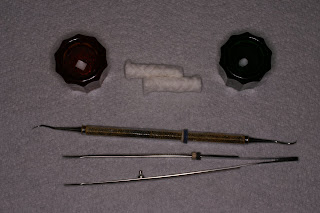
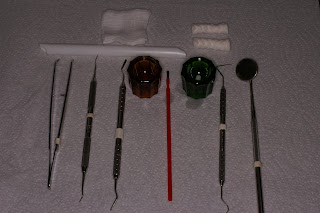

Various dental products are used to decontaminate the crown and the tooth. Chemical agents are also used for preventing bleeding from the gums.
Also, before mixing the new cement, the old cement must be cleaned out.

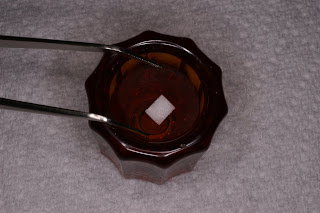
The direction that the crown faces must be known.
When in doubt try laying the tooth down in various directions to determine the correct orientation.


Thank you for reading,
Dr. Ray
Dr. Raymond E. LaVigne DDS is a practicing dentist in the Chicagoland area for over 30 years.
Please call our Palatine, IL dental office for an appointment: 847-359-1292.
Here are some examples of products used by patients at home (real life stories from my office!) They are absolutely not recommended to be used in the mouth or to repair any appliance that is placed in the mouth.

Temporary cements available in pharmacies or even at your dental office may be free of toxic substances in household or commercial adhesives, but still need to be used with caution as I will explain in a minute.


Below are the various cements and tools used by dentists for temporary and final cementation. In an office such as ours, we typically have 6 – 10 types over a wide range of strength. The photo in the middle shows a typical set up in a dental office for cementing or recementing. Dentists have cleansers for both the tooth and the crown. They also have water spray, suction and cotton rolls at their disposal. Their instruments include spatulas for proper mixing and loading, mirrors for looking into as well as guarding the tongue or cheek once the tooth is cleaned and dried.


Various dental products are used to decontaminate the crown and the tooth. Chemical agents are also used for preventing bleeding from the gums.
Also, before mixing the new cement, the old cement must be cleaned out.


The direction that the crown faces must be known.
When in doubt try laying the tooth down in various directions to determine the correct orientation.


Thank you for reading,
Dr. Ray
Dr. Raymond E. LaVigne DDS is a practicing dentist in the Chicagoland area for over 30 years.
Please call our Palatine, IL dental office for an appointment: 847-359-1292.

