9/10/11

Broken crown or temporary? Read before you DIY

Dr. Raymond E. LaVigne practices dentistry in Palatine, Illinois.  His specialties are cosmetic dentistry, dental implants, and patient education. The focus of this article will be to help patients avoid the problems associated with delay in seeking professional care with or without an attempt to repair or glue teeth themselves at home.


F.Y.I. why D.I.Y. may not always be I.Y.B.I. ( in your best interest)
Life has its surprises. In addition to all the possible mishaps with our homes, cars, plans and the weather to mention a few; our teeth will sometimes add to our daily challenges.
Typical scenarios are a broken or lost filling, loose or lost crown or bridge or perhaps some type of breakage with a full or partial denture. Less common is a sudden problem to natural tooth enamel.

The most common reasons for these problems are:
  • An extra hard shock to our tooth or restoration while eating
  • Eating something of more than recommended hardness or stickiness
  • Using our teeth as tools
  • Clenching and tooth grinding due to stress
  • Dropping our mouth appliance on the floor or sink
  • Traumatic injury – falling down, running into something or somebody
The above factors can cause a good tooth or strong restoration to break or become loose.
When a tooth has already been weakened by decay or has a filling or crown that is not in good condition, even mild forces can cause damage.
Another possibility is when we are undergoing treatment and have a temporary filling or crown or bridge, denture, etc. Brushing too vigorously or chewing even the softest foods can break or dislodge temporaries. Dislodging temporaries while flossing is also a possibility.

(images of broken crowns and temporaries)
 dislodged tooth crown

broken tooth crown

The problems we see or hear about most commonly are:
1) The crown or bridge does not get reinserted correctly – bite is off; restoration is raised so that repeat loosening is a probability and worse yet, decay or serious staining can get under the crown.
2) The tooth does not get cleaned and dried without having access to dental instruments and equipment and professional experience.
3) The excess glue cannot be adequately cleaned off or the crown is bumped loose in the attempt.
4) The patient secures the crown or bridge but does not follow up with the dentist. In the future significant decay is found.
5) The glue sticks to the patient’s fingers, lips, tongue or opposing teeth.
6) The restoration falls into a sink or is swallowed.


Here are some examples of products used by patients at home (real life stories from my office!) They  are absolutely not recommended to be used in the mouth or to repair any appliance that is placed in the mouth.


NOT dental glue!

Temporary cements available in pharmacies or even at your dental office may be free of toxic substances in household or commercial adhesives, but still need to be used with caution as I will explain in a minute.
DIY denture fix
denture fix DIY

Below are the various cements and tools used by dentists for temporary and final cementation. In an office such as ours, we typically have 6 – 10 types over a wide range of strength. The photo in the middle shows a typical set up in a dental office for cementing or recementing. Dentists have cleansers for both the tooth and the crown. They also have water spray, suction and cotton rolls at their disposal. Their instruments include spatulas for proper mixing and loading, mirrors for looking into as well as guarding the tongue or cheek once the tooth is cleaned and dried.
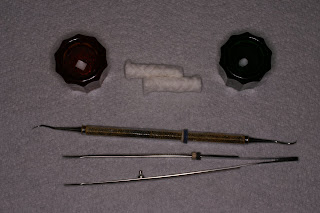
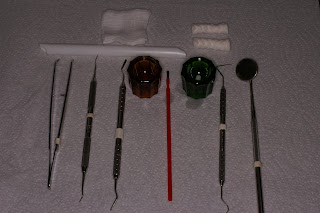
dental cement material

dentist tools cementation

dental crown cement

Various dental products are used to decontaminate the crown and the tooth. Chemical agents are also used for preventing bleeding from the gums.
 
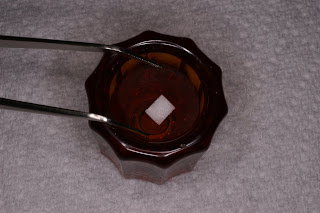
Also, before mixing the new cement, the old cement must be cleaned out.


crown cleaning


temporary tooth sanitation

The direction that the crown faces must be known.
When in doubt try laying the tooth down in various directions to determine the correct orientation.
top of tooth temporary

underlying of crown

Thank you for reading,
Dr. Ray

Dr. Raymond E. LaVigne DDS is a practicing dentist in the Chicagoland area for over 30 years.
Please call our Palatine, IL dental office for an appointment: 847-359-1292.

tooth repair in one day

Dr. Raymond E. LaVigne practices dentistry in Palatine, Illinois. His specialties are cosmetic dentistry, dental implants, and patient education. This article focuses on the concept of repairing a tooth and/or dental implant in one day's worth of procedures. There are many pros and cons to this practice. 

While it may seem tempting to have all of your teeth problems fixed in one day, this may not be the healthiest reality.

For example, the procedure of placing 6 implants, allowing 4-6 months for healing and later delivering a full denture that is screwed down over the implants has been a successful treatment option for over 10 years.

Recently, the concept has been advanced to placement of the implants immediately after extracting remaining teeth and also placement of the denture attached to those implants in the same visit. In addition, reducing the number of implants to 4 has been used.

This works wonders for some patients who qualify for this major treatment. However. there are many who cannot have this same treatment regimen. In order for the "all on four, teeth in one day" to be realized, there are indications and prohibited conditions. In order for implants to be placed immediately following extractions in general:

The teeth being extracted must either be distant enough from the implant sites or the bone must be adequate to allow an implant wider and f or longer than the extraction site. There should be no active infection.

Although prosthetic teeth are placed immediately, there must be absolute compliance by the patient with regard to eating extremely softly for the recommended time frame. There must also be provision made to prevent the effect of bruxism (teeth grinding during sleep) from damage to and failure of the implants healing within the bone.

The total surgical and restorative procedure is at a fairly high cost in a short period of time. Even with zero percent financing, some patients find this difficult to fit into their overall budget.

The good news is that there are other options for patients to consider. Rather than make a quantum leap to a denture loaded upon 4 implants in one appointment, patients can elect to go much more gradually. As an example, teeth can be extracted one or a few at a time. Implants can be placed one or two at a time. Extraction sites can be allowed to heal and Implants can be left unloaded in the traditional fashion for at least 3 months. The patient is fitted with a temporary partial denture or temporary plastic fixed bridges. These can be modified as the treatment progresses. Implants that have been confirmed as integrated into bone can then be used as' anchors while additional teeth are extracted and more implants placed.

The above approach allows for treatment to be phased in over a much longer time frame. While the concept of everything done quickly is appealing to some, it is not for everyone.

The advantages of the gradual phase in method are as follows:

1) Conservatively allowing time for healing of extraction wounds, bone grafts, implants
and confirming this stability before relying on their support for chewing.

2) Extend financing even further by doing the treatment in smaller phases still possibly using zero percent financing.

3) Avoiding complications from infection, night clenching.
4) Give patient opportunity to gradually become acclimated to having implants and doing the necessary daily care before they invest in everything on 4 - 6 implants.

5) Allow more opportunity to make adjustments to the appearance and occlusion (bite) by a more gradual transition and ability to do more try in visits before the prosthesis is completed.

Thank you for reading,
Dr. Ray


Dr. Raymond E. LaVigne DDS is a practicing dentist in the Chicagoland area for over 30 years.

Please call our Palatine, IL dental office for an appointment: 847-359-1292.

should I get a root canal or implant?

Dr. Raymond E. LaVigne practices dentistry in Palatine, Illinois. His specialties are cosmetic dentistry, dental implants, and patient education. This article will highlight root canal treatments, causes of needing a root canal, and possible benefits, risks, and complications of having a root canal procedure.

 
Root canal treatment involves the removal of the pulp (soft tissue from the channel within the root of a tooth). The pulp is comprised of blood vessels, connective tissue and nerve. The pulp is needed when a tooth is in active growth stages. The blood vessels provide calcium as the tooth matures from the inside. The walls of the root (as well as the visible coronal part of the tooth) grow thicker as the calcium is transformed into dentin.

Roots typically reach maturity in length and thickness of the walls within about 2 – 3 years after the tooth erupts into the mouth.

After that time, additional calcification may continue. Additional calcification comes as a response to such stimuli as:

  • Hot or cold temperatures – the tooth attempts to further “insulate” itself
  • Decay – the tooth attempts to repair itself as decay advances from the outside
  • Unusual biting or clenching forces – the tooth calcifies inside the pulp canal as a response to the on and off pressures felt at the apex of the root where the blood vessels enter and exit the end of the root.

Common reasons for needing a root canal include:

1) Decay has accelerated beyond the ability of the repair process so that bacteria enter the pulp from the outside. In some cases there is direct entry of bacteria. In other cases, the acidic excretions of bacteria cause the irritation and pain, but there is no actual infection.

2) Tooth fractures allow bacteria or their acidic excretions to come in contact with the pulp.

3) Tooth trauma. Sudden force can cause the tooth to be intruded into the bony socket. This can sever the blood vessels so that the tooth no longer has live blood flow within. This causes the remaining soft tissue of the pulp to break down ("dead nerve"). Having a dead nerve or necrotic pulp can temporarily mean no pain but later can lead to infection from the toxic debris.

4) Teeth clenching. Constant, repetitive forces can cause the same cutting off of the blood flow. Clenching can slowly cause the pulp to calcify along the canal walls. As the channel becomes smaller in diameter, blood flow gradually decreases. Another response to abnormal forces is a pulp stone. Instead of or in addition to narrowing of the canal walls, a pulp stone accumulates in the pulp chamber. At some point it can also cut off the flow of blood.

5) Restoration needs.  Sometimes a root canal is recommended or necessary in order to provide proper strength or adherence of a filling or crown. Sometimes there is no direct exposure of the pulp however, the preparation for the filling or crown will either expose the pulp or come so close that the tooth will be extremely sensitive and have a high

Some teeth having previously large fillings or crowns or having major fractures will need a post in order to retain a new crown. A post can only be placed if a root canal is performed first.

 
Factors that make root canals highly successful:

  • Vital: fresh pulp – little or no bacterial contamination
  •  
  • Normal to fairly large canals
  •  
  • Straight to slightly curved root forms
  •  
  • Technique, details followed during treatment
  •  
  • Good to excellent placement of temporary filling
  • Good and timely placement of permanent restoration following root canal

Factors that complicate root canal treatment:

  • Some bacterial contamination of the pulp
  •  
  • Significantly small diameter canals 
  •  
  • Highly curved or irregular root forms
  •  
  • Intersecting or lateral accessory canals – tiny side branches from the main canal
  •  
  • Significant wall calcification or pulp stone making entry and negotiation difficult
  •  
  • Delay is seeking initial treatment or completing permanent restoration
  •  
  • Challenging situations such as location of tooth, ability to open wide, ability to effectively isolate the tooth with a rubber dam, alignment issues that make taking accurate x-ray difficult
  • Re-treatment of root canals with no structural challenges but with return of bacteria from a recurrent cavity allowing bacteria to reach the previously sealed canal

Factors that make root canal treatment highly risky:
  • Gross bacterial contamination, long-term and beyond the canal into surrounding bone, possibly sinus involvement
  •  
  • Extremely curved and also very small diameter combinations
  •  
  • Complete calcification so that a canal cannot be entered even with the finest file size
  •  
  • Extremely large pulps such that walls are thin and vulnerable to fracture
  •  
  • Failure by patients to follow through with permanent restoration
  •  
  • Re-treatment of root canals with major complications such as blocked passages and other obstacles
  • Teeth that have been grossly exposed to bacteria for an extended time so that the tooth structure is highly compromised – Softened or thin and brittle will not allow long term success with restorations – fillings will not hold, cemented crowns will not adhere long term or there is a high chance of fracture simply from normal chewing.

Implants may be a better option rather than perform extensive procedures (i.e. getting a root canal) with great risk.

With all the advancements, implant placement and restoration has become much more reliable and predictable.
Thank you for reading,
Dr. Ray


Dr. Raymond E. LaVigne DDS is a practicing dentist in the Chicagoland area for over 30 years.
Please call our Palatine, IL dental office for an appointment: 847-359-1292.
Related Posts Plugin for WordPress, Blogger...