How do you decide whether to seek dental treatment? Are you usually preventive minded and proactive? Do you only call when you sense discomfort or an obvious cavity, fracture or serious gum problem?
When you do decide to schedule with a dental office are you referred by a friend or family member or do you search the internet or telephone book or other direct ads? Do you consider any dental practice or are you strongly motivated to go where your dental insurance is in network for PPO discounts versus normal acceptance of your plan?
Do you believe there may be any difference in the quality of treatment you receive based on cost?
Is the treatment that you need so routine that you feel it makes little difference.
If you do need major procedures such as a root canal or bridge or some treatment of your front teeth would that make a difference? Do you believe that all dentists have similar experience and spend the same amount of time or use the same quality labs and supplies?
For some patients the answers to some or many of these questions is: "It does not matter at all or very much". They will then be highly persuaded to go with the "cheaper and faster the better" formula.
Many other patients do realize there is a difference.
It is true that new dental graduates will have very similar training. After that point there will be a very wide range. Doctors have choices to make regarding what equipment and supplies they purchase. They can very greatly with respect to the additional training they receive and use after dental school. They also have the ability to choose how much time they want to spend on patients and relate their focus and time to the fees they charge. The Dentist and staff spend time diagnosing your health status and then educating you. They not only perform your actual treatment but also strive to make you comfortable during that treatment and when providing you with temporaries and post op care. In addition to the amount of focus and time spent , there can be much variation regarding quality of lab work and materials used for your treatment.
We believe patients have the right and responsibility to choose. It is a good thing to have dental insurance. It should be seen as a helpful benefit whether it pays in full or just a portion.
Unfortunately too many patients are strongly swayed by things that are not under their direct control. Your employer or union often decides which insurance plans to offer. Your insurance plan decides which procedures to cover and to what extent. The fee schedule designed by your particular plan may be anything from very basic to generous. It is really up to you, the patient to decide what you are comfortable with.
In the last 5 to 10 years there has been a great amount of change within dental insurance. As we all know, there have been major changes due to the Affordable Care Act (Obama Care). Thus fare the effect on dental and eye care has been minimal and indirect compared to medical coverage and for some the ability to sustain a full time employment.
I believe that our influence by politicians and insurance companies has already had significant effects on dental as well as medical care. While the goal was to spread health care to those less fortunate, there has unfortunately been adverse effects on those who previously had coverage and access to care. Many of us realize that there are ranges and different standards.
I will address this more in my next blog.


9/7/13
Post treatment guide for dental implants
**These are GENERALIZED instructions for your information only; they are not to be used for self-diagnosis or self-treatment. Please see your personal dentist for your own care.**
Post Treatment Instructions
First 24 Hours
Completely avoid eating and
brushing and touching area
Use cold pack gently outside skin for first 1 – 2
hours on and off 10 minutes
Usually all bleeding has
subsided by time you are dismissed. There is some possibility of the return of
bleeding later as the local anesthetic wears off and the Adrenaline effect on
the blood vessels ends. It is normal for your mouth to have the taste of blood
and for a very small amount of clotted blood to mix with your saliva. However,
if you actually develop bleeding do the following:
Place a cold pack back on the
outside of your face in the area and place a wet tea bag insiden the mouth directly over
the site and gently bite to allow the tea to coagulate the blood
Unlike usual extractions – DO NOT BITE ON GAUZE – pressure may
disturb implant, bone graft healing process
Days 2 – 14 Continue to avoid eating and brushing in surgical area
completely
Restrict all eating to the opposite side of the mouth.
Chew carefully
The most important
requirement is to avoid disturbing the area while healing is proceeding.
If a tooth was extracted,
bone grafting, implant placed either separate or in combination; any force will
cause shifting and will disrupt closure of the surgical site, movement of bone
graft materials or membranes. Implants must be integrated within the bone for a
minimum of 90 days for routine conditions before being subjected to force from
chewing.
In lieu of contact even with
a soft tooth brush applied gently, we recommend:
Rinse 3 – 7 times daily with baking soda (one teaspoon dissolved in 8oz
water)
There is also available a
mouthwash with baking soda as the main ingredient. ( Tom's )
Use of temporary bridges,
retainers, dentures - It is extremely
important to prevent any direct forces on healing tooth sockets,
bone grafts and healing implants.
Special
Instructions
Day 15 – 1 Month
sutures have been removed and the doctor has
verified initial healing:
For two additional weeks
after suture removal do brush the teeth adjacent to the extraction, bone graft,
implant still being very gentle - only clean the teeth - do not massage the gum
tissue that was involved in the surgery. Floss gently any adjacent teeth but do
not force floss into crevice of gums immediately in the area of any implant or
bone graft
Continue eating carefully
still avoiding even soft foods on the surgical area.
Any
temporary restoration worn during the healing period should exert zero force on
the area surrounding the implant and any bone grafted area.
Month 1 through
[ ] 4
[ ] 6
[ ] 8
dependant on how many phases
from toothy extraction through the time implant is determined to be fully
integrated (secure in the bone)
During this time there are
two very important requirements to adhere to
1) Forces upon the healing graft or implant must be avoided entirely
2) Cleanliness is imperative
throughout the remaining period for healing - and forever thereafter!
Since there is a wide range
of situations, I will describe all of them and note which ones pertain to your
individual circumstances
Stage one - No exposed Implant structure and no
temporary appliance
Avoid eating moderate to
crunchy and sharp foods in the area
Brush and floss adjacent
teeth like normal
Healing Abutment exposed to the surface
Avoid anything but extremely
soft from contacting the exposed Titanium part
In addition to normal care
for the neighboring teeth keep the abutment and surrounding gum tissue clean
by gentle brushing in a circular motion
Healing Abutment with a Removable temporary
appliance
Use the same above
precautions to avoid forces upon the exposed metal part and to keep it clean.
Eat with the temporary
appliance in place according to your previous instructions based on the
durability and stability of your particular temporary. Clean the removable
appliance at least three times daily - as soon as possible after each meal. If
you detect any movement where the appliance transmits force to the abutment or
the gum tissue around it call the office and avoid further use until adjusted
Multiple Implants with a Temporary Full or Partial
Denture
Avoid use of denture adhesive
while stitches are in place and until gum tissue has healed closed - usually 2 - 4 weeks after extraction or implant
placement.
Keep denture clean outside
and under brushing soon after every meal
There should be no force upon
the healing sites - any force from chewing must be on the palate and remaining
teeth and ridge areas that are well healed where teeth have been missing for
more than a year.
Eat only soft foods the first
30 days and only gradually to moderate chewing until your implants are
integrated and a permanent denture or bridge is placed
crown or bridge attached to implant(s)
You were supplied with a
temporary attached to the implant for the purpose of shaping the surrounding
gum tissue in the final stages of healing.
In some cases (this is to be avoided since it
is a compromised situation with much higher risk) a temporary may be attached
to the implant immediately or much sooner than the time of full integration due
to the impossibility of fitting a suitable removable temporary and a strong
need for cosmetic appearance during healing.
[ ] Phase one - completely avoid all eating
that would contact the temporary tooth and transmit forces - Extremely Important - not even
soft contact. Do not brush the temporary but instead rinse 3 - 7 times daily
with baking soda solution
[ ] Phase two - still continue to completely avoid eating on the temporary.
Brush with most gentle brush
and method Do Not Floss the
area
[ ] Phase three - Now we are in transition
toward the final replacement tooth crown or bridge. Start eating very soft
foods on the temporary. Brush with normal massage of the gum tissue like you
would for any other teeth. Begin flossing around the temporary very gently with
light force only against the temporary and no force from the floss exerted
against the gum tissue
Special Instructions
You have been recommended to
wear an appliance at night - either your temporary denture, a second denture or
a night guard retainer. This is extremely important since we need to remove all
risk of forces on the healing site, any implants with healing in progress, any
implants that will stand alone (when usual day time denture is removed) even
after they have fully integrated within the bone (we need to assure that they
will not loosen, break screws, etc.) We also need to avoid unbalanced forces on
any remaining teeth or trauma to your lips or tongue, etc. caused by clenching
teeth during sleep especially when there are few remaining teeth that would be
very vulnerable to problems.
In addition to protection,
this allows the opportunity for soaking of removable dentures or retainers for
maximum disinfection when they are out of your mouth.
Other:
After PERMANENT restoration
Gradually increase chewing
reaching normal frequency and texture of foods.
Always avoid extremely hard chewing such as ice, hard
candy, shells, stale nuts
and using your teeth as a tool or for bad habits.
Keep in mind that anything
too strong will cause damage to natural tooth enamel, porcelain and other
restorative materials, dental cements (even permanent) and can result in broken
screws, loosening of crowns, bridges, posts, implants or teeth themselves.
Brush normally and often Floss gently around any
Crown, etc. placed on top of the implant . Do not force floss deep under the gums
around the body of the implant gums do not attach as firmly to an implant as
a tooth root Gum and bone grow closely around an implant, but do
not biologically connect
Implants will not be subject
to cavities, but they are highly vulnerable to gingivitis.
Eat well without overloading Use excellent cleaning at home and be
consistent with follow up care every 3 - 6 months as recommended
Summary - Instructions
for Dental implants
1) Day before / day of
surgical placement
Take anti-inflammatory pain
medication 1 - 12 hours in advance to prevent excess swelling and pain
Take antibiotic starting day
before to prevent infection
2)After surgery through two
weeks - removal of stitches
Completely avoid eating in
area
Completely avoid brushing and
flossing in area
Instead rinse gently and
frequently ( 5 - 10 times a day) with baking soda solution or baking soda mouth
wash only
Completely avoid use of any
removable false teeth, temporary, retainer, night guard unless you were
specifically instructed to do so and given special instructions for wearing and
cleaning, removal
3) Following removal of
stitches
brush adjacent teeth gently
but thoroughly
rinse briskly with any type
of mouthwash at least 3 times daily in area of implants
still do not floss the gum
tissue next to any implant
If a screw or healing
abutment is exposed now or becomes exposed in later weeks, begin gently
brushing the exposed metal with a circular motion.
Under no circumstance should any force be
placed from chewing upon an implant prior to a minimum 3 month period for
integration (healing within your jaw bone)
exceptions are specially
given when a patient has received a full arch set of implants that are joined
by a rigid bar and a special secure temporary - still use great caution to chew
very softly for the initial 3 month period
4) After restoration of
implants
once any single crown, bridge
or removable restoration is attached to the implant:
Chew softly at first then
gradually increase until normal (mildly crunchy) can be accomplished - usually
over a period of a week.
brush the fixed restorations
the same as any natural tooth covered with a crown, bridge
Do floss the gum tissue over
the implant - extremely gently - wipe gently against the implant and crown - do
not use any force pushing against the gums surrounding any implant now or ever
in the future
removable partials and full
dentures are removed for cleaning three times daily and the implants should be
brushed with a gentle circular motion.
**These are GENERALIZED instructions for your information only; it is not to be used for self-diagnosis or self-treatment. Please see your personal dentist for your own care.**
9/10/11
Broken crown or temporary? Read before you DIY
Dr. Raymond E. LaVigne practices dentistry in Palatine, Illinois. His specialties are cosmetic dentistry, dental implants, and patient education. The focus of this article will be to help patients avoid the problems associated with delay in seeking professional care with or without an attempt to repair or glue teeth themselves at home.
The most common reasons for these problems are: 

The problems we see or hear about most commonly are:
F.Y.I. why D.I.Y. may not always be I.Y.B.I. ( in your best interest)
Life has its surprises. In addition to all the possible mishaps with our homes, cars, plans and the weather to mention a few; our teeth will sometimes add to our daily challenges.
Typical scenarios are a broken or lost filling, loose or lost crown or bridge or perhaps some type of breakage with a full or partial denture. Less common is a sudden problem to natural tooth enamel.
The most common reasons for these problems are:
- An extra hard shock to our tooth or restoration while eating
- Eating something of more than recommended hardness or stickiness
- Using our teeth as tools
- Clenching and tooth grinding due to stress
- Dropping our mouth appliance on the floor or sink
- Traumatic injury – falling down, running into something or somebody
The above factors can cause a good tooth or strong restoration to break or become loose.
When a tooth has already been weakened by decay or has a filling or crown that is not in good condition, even mild forces can cause damage.
Another possibility is when we are undergoing treatment and have a temporary filling or crown or bridge, denture, etc. Brushing too vigorously or chewing even the softest foods can break or dislodge temporaries. Dislodging temporaries while flossing is also a possibility.
(images of broken crowns and temporaries)
(images of broken crowns and temporaries)


The problems we see or hear about most commonly are:
1) The crown or bridge does not get reinserted correctly – bite is off; restoration is raised so that repeat loosening is a probability and worse yet, decay or serious staining can get under the crown.
2) The tooth does not get cleaned and dried without having access to dental instruments and equipment and professional experience.
3) The excess glue cannot be adequately cleaned off or the crown is bumped loose in the attempt.
4) The patient secures the crown or bridge but does not follow up with the dentist. In the future significant decay is found.
5) The glue sticks to the patient’s fingers, lips, tongue or opposing teeth.
6) The restoration falls into a sink or is swallowed.

Temporary cements available in pharmacies or even at your dental office may be free of toxic substances in household or commercial adhesives, but still need to be used with caution as I will explain in a minute.

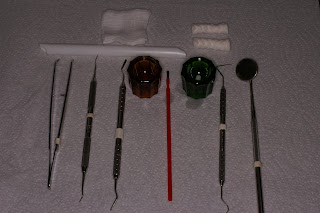
Below are the various cements and tools used by dentists for temporary and final cementation. In an office such as ours, we typically have 6 – 10 types over a wide range of strength. The photo in the middle shows a typical set up in a dental office for cementing or recementing. Dentists have cleansers for both the tooth and the crown. They also have water spray, suction and cotton rolls at their disposal. Their instruments include spatulas for proper mixing and loading, mirrors for looking into as well as guarding the tongue or cheek once the tooth is cleaned and dried.
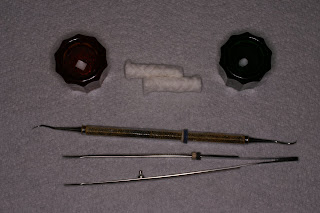

Various dental products are used to decontaminate the crown and the tooth. Chemical agents are also used for preventing bleeding from the gums.
Also, before mixing the new cement, the old cement must be cleaned out.

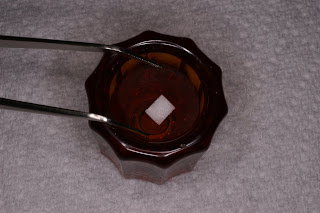
The direction that the crown faces must be known.
When in doubt try laying the tooth down in various directions to determine the correct orientation.


Thank you for reading,
Dr. Ray
Dr. Raymond E. LaVigne DDS is a practicing dentist in the Chicagoland area for over 30 years.
Please call our Palatine, IL dental office for an appointment: 847-359-1292.
Here are some examples of products used by patients at home (real life stories from my office!) They are absolutely not recommended to be used in the mouth or to repair any appliance that is placed in the mouth.

Temporary cements available in pharmacies or even at your dental office may be free of toxic substances in household or commercial adhesives, but still need to be used with caution as I will explain in a minute.


Below are the various cements and tools used by dentists for temporary and final cementation. In an office such as ours, we typically have 6 – 10 types over a wide range of strength. The photo in the middle shows a typical set up in a dental office for cementing or recementing. Dentists have cleansers for both the tooth and the crown. They also have water spray, suction and cotton rolls at their disposal. Their instruments include spatulas for proper mixing and loading, mirrors for looking into as well as guarding the tongue or cheek once the tooth is cleaned and dried.


Various dental products are used to decontaminate the crown and the tooth. Chemical agents are also used for preventing bleeding from the gums.
Also, before mixing the new cement, the old cement must be cleaned out.


The direction that the crown faces must be known.
When in doubt try laying the tooth down in various directions to determine the correct orientation.


Thank you for reading,
Dr. Ray
Dr. Raymond E. LaVigne DDS is a practicing dentist in the Chicagoland area for over 30 years.
Please call our Palatine, IL dental office for an appointment: 847-359-1292.
Dentures in full detail
Dr. Raymond E. LaVigne practices dentistry in Palatine, Illinois. His specialties are cosmetic dentistry, dental implants, and patient education. This arcile outlines various types and sizes of dentures and which one may be right for you.
This article will describe different types of dentures; i.e. treatment options when all teeth within an arch (upper or lower) are missing already or need to be extracted.
This article will describe different types of dentures; i.e. treatment options when all teeth within an arch (upper or lower) are missing already or need to be extracted.
- Full denture
- Full denture retained by 2 or more remaining teeth over denture
- Full denture retained by 2 or more mini implants
- Full denture retained by 2 or more standard implants with bars attached
- Full denture screwed down to multiple implants
- Long-span fixed bridge cemented or screwed onto multiple implants
1. Full Denture
- Supported entirely by resting upon the ridge bone and palate in the case of uppers.
- Retained by fitting into undercut areas.
- -Least costly investment initially; does require relines recommended about every year at the start then about every three years on the average
- teeth wear, bone resorbs so that a new denture is typically needed after every 5 years
- May require adhesive paste to provide additional retention initially for major chewing and later for all eating and speaking
Ridge bone continues to be lost due to two reasons:
- Atrophy - lack of use since no more tooth roots embedded in bone
- Resorption - forces upon bone as denture shifts during chewing causes stress
Resorption is magnified and accelerated the longer the denture is worn without relining and the more unbalanced the bite is from the start (over bite, irregularities) or has become due to uneven wear of the teeth (especially a problem when various teeth oppose the denture - some natural enamel, some porcelain, various types of filling materials). Dentures must be made and maintained in harmony with the surrounding muscles.The tongue is an especially important factor in having success with lower dentures.
More to consider with full dentures:
- Denture can be made to be attractive and natural looking
- When initially fitted dentures allow about 25% of the chewing force possible with strong full set of natural teeth
- Undercuts give dentures retention but also can be a source of sore spots
- Two or more teeth with reasonably healthy bone and gum tissue can be saved so that a denture can be retained over them - The denture is still completely supported by resting on the gums and underlying bone The remaining teeth provide retention only.
- Saving teeth also saves bone thus avoiding even more atrophy - the bone stays around the roots as long as forces are normal
- The denture can be retained by a variety of options: silicone rubber, O- Rings or "snap "attachments, clips on a bar.
- Teeth saved must be in good condition and must be maintained by good home care and professional cleanings in order to make this feasible.
- Attachments work well when there are poor existing undercut areas and / or very strong muscles wanting to dislodge the denture.
- The forces used when chewing should still be within the 25 - 35% range. Care should be used in type of food and force used so that the attachments and remaining tooth roots are not overloaded. A night time retainer or second denture is often made to prevent clenching upon the attachments while sleeping.
3. Full denture retained by 2 or more mini implants
- Denture is supported by the gums and bone Implants provide retention typically by silicone rubber or attachments like a snap.
- The mini implants help prevent further atrophy of the ridge bone sine the implant acts similar to a tooth root.
- Mini implants are great when teeth are not available, are in poor condition, or are poorly spaced for proper balance and stability.
- Mini implants are usually one piece - that is implant and abutment all in one.
- Mini implants are indicated in the lower front area due to their size and the type of bone density found in this area - which is typically the densest bone in the mouth.
- In some cases the denture can be fit to be retained by the implants in the same appointment due to the dense bone allowing for immediate stability.
4. Full denture retained by 2 or more standard implants with bars attached
- Four or more standard size implants are strategically placed and joined by bars that are screwed down to the implants forming a frame. The denture has retention clips that fit over the bar usually in 2 - 4 places. In this case the denture rests upon the bar and is passive to the gum and bone tissues.
- Dentures supported by bars can typically allow 50 - 60 % of maximum chewing force (based on natural teeth)
- Dentures are removed for cleaning. Implants and bars require cleaning with brush and floss with moderate effort needed. As with any implant, professional exam and cleaning are recommended every 6 months and, in some cases, every 3-4.
5. Full denture screwed down to multiple implants
- Four or more standard size implants are placed and joined by bars similar to the above clip on but removable denture over bars. In this case, however, the denture is screwed onto the bar and not removable by the patient. These appliances allow 60 - 80% of maximum chewing ability. Since they can not be removed for cleaning after each meal, the denture borders are raised off the gum tissue enough to allow floss to pass under the base. Also frequent brisk rinsing and use of an irrigator such as a "Water-Pik" are highly recommended for cleaning several times each day.
- The bar under-structure is similar to the previous over denture however the denture is not removable by the patient since it is screwed down to the bars.
6. Long-span fixed bridge cemented or screwed onto multiple implants
- Multiple single crowns allow best appearance and easiest flossing.
- Implants can also be abutments for several bridge sections or one long span bridge for the entire arch.
- These restorations allow maximum cosmetic appearance since the crowns are made from porcelain which has natural translucency, many shades are available and shades can be custom blended.
- These restorations are the strongest and can deliver 80 - 90% chewing force.
Excellent daily home care is needed just like when a patient has many remaining natural teeth heavily restored by crowns or bridges. That means flossing between the implants.
Implants help maintain jaw bone since they give the bone a purpose - the bone in use with normal amount of force stays healthy - similar to exercising for muscles and joints.
In many cases a patient wears a partial or full denture as a temporary when they ultimately plan to have implants as their long term tooth replacement. Having good fitting and nice appearing partial or full dentures prevents further damage to remaining teeth and also protects implants as they heal within the bone. Having a good partial or full denture and also a dentist who knows how to customize and modify them, can be a great advantage when a patient desires implants but will need a year or even much longer before completion.
Dr. Raymond E. LaVigne DDS is a practicing dentist in the Chicagoland area for over 30 years.
Please call our Palatine, IL dental office for an appointment: 847-359-1292.
Thank you for reading,
Dr. Ray
Please call our Palatine, IL dental office for an appointment: 847-359-1292.
Subscribe to:
Posts (Atom)
